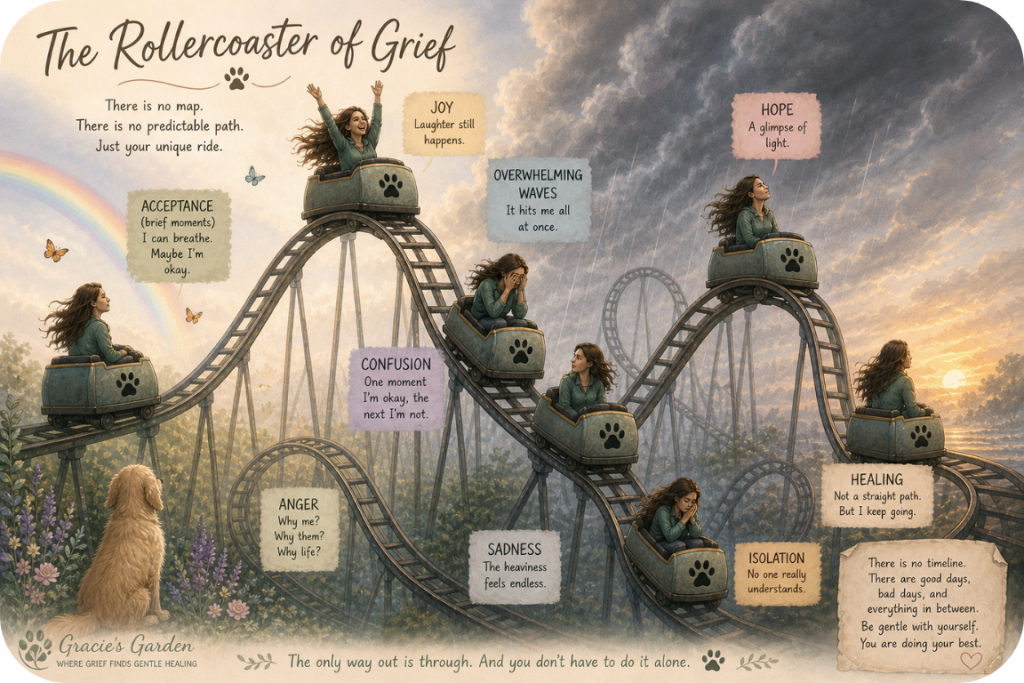
When you lose a beloved dog, the world doesn’t just feel different — it can feel completely upside down. One moment you’re remembering their silly grin and laughing through tears, and the next, you’re overwhelmed by the sharp, breath-stealing ache of their absence. Many grieving dog parents describe these emotional shifts like a rollercoaster: sudden turns, steep drops, unexpected rises, and moments that leave you feeling unsteady and unsure of what comes next.
If this is what your days look like, please know this: you are not broken. You are grieving.
And grief, by its very nature, moves in waves.
Why Grief Refuses to Follow a Straight Line
We often hear about the “stages of grief,” as if we’re supposed to move through loss in some orderly sequence. But real grief — especially the grief of losing a dog who was part of your daily life — rarely behaves that way.
Your emotions may swing wildly:
- You feel steady one morning… then fall apart in the afternoon when you find a forgotten toy under the couch.
- You laugh at a goofy memory… then feel guilty for laughing.
- You feel numb for hours… and then suddenly overwhelmed.
This unpredictability isn’t a setback — it’s simply how grief works. Loss is disorienting. Love is deep. And healing is not linear.
Think of grief as the tide:
Sometimes gentle enough to walk beside… sometimes crashing with unbearable force.
Both are valid. Both are part of healing.
The Ups: The Surprising Moments of Comfort
One of the most confusing parts of grief is that even in the early days, moments of warmth still appear — and they can feel almost startling.
You might:
- Laugh through tears remembering the way your dog used to sit crooked or howl off-key.
- Smile at a photo of them in their puppy days.
- Feel a sense of peace during a quiet moment, as if their spirit is still walking beside you.
These “ups” are not betrayal. They are not signs that you’re “moving on” too quickly.
They are gifts — small reminders that love doesn’t vanish, even after loss.
The Downs: When the Weight Feels Crushing
Then come the plunges — the days when grief sits so heavily on your chest it’s hard to breathe. The moments when ordinary life feels impossible. The instant triggers that reopen the wound:
- Coming home to a house that feels too quiet.
- Calling their name out of habit.
- Passing the dog food aisle.
- Seeing a dog who looks just like yours.
These moments can feel like falling backwards. But they are not failures. They are reflections of the depth of your bond — and how intertwined your dog was with your daily world.
Why This Emotional Rollercoaster Feels So Intense
Grieving a dog can feel more overwhelming than people expect — and there are real reasons why:
- Constant Companionship
Dogs aren’t occasional presences — they’re woven into your routines, your rhythms, your home, your heart. Their absence touches every corner of your life.
- Unconditional Love
The love between a dog and their human is pure, uncomplicated, and without judgment. Losing that steady source of comfort is devastating.
- Disenfranchised Grief
Society often minimizes pet loss, leaving dog parents feeling unseen or dismissed. When others don’t validate your grief, the ups and downs feel even more isolating.
The Guilt Loop
Guilt is one of the most painful — and most common — parts of grieving a dog. It can show up as:
- “Did I make the right decision at the end?”
- “Should I have noticed something sooner?”
- “I should have given them more time, more walks, more treats…”
But guilt is not proof of failure.
Guilt is love with nowhere to land — a heart trying to rewrite what was never in your control.
Your choices were made out of compassion.
Your dog knew they were loved beyond measure.
That is what mattered most.
Coping With the Highs and Lows
The goal isn’t to avoid the emotional swings, but to support yourself within them.
- Name What You’re Feeling
When the wave hits, pause and identify it: sadness, anger, guilt, relief, longing.
Naming emotions softens their intensity.
- Create Simple, Safe Rituals
Light a candle.
Hold their collar or a pawprint charm.
Say their name out loud.
Rituals give the heart an anchor when everything feels chaotic.
- Journal Without Expectation
Write letters to your dog.
Write your gratitude.
Write your frustrations.
No judgment — just release.
- Lean on Compassionate People
Surround yourself with people (or communities like Gracie’s-Garden) who validate your grief.
Limit time with those who minimize it.
Your heart deserves gentleness.
- Give Yourself Permission to Feel Everything
You can cry in the morning and laugh in the afternoon.
You can feel broken and healing in the same hour.
This is grief’s rhythm — not a contradiction.
What to Hold Onto on the Hard Days
- There is no timeline for grief.
- Healing does not mean forgetting.
- Love remains — even in absence.
- Your grief is valid, whether others understand it or not.
- You are doing your best, even on the days that feel impossible.
A Gentle Closing Ritual
If the rollercoaster feels overwhelming today, try this moment of grounding:
- Sit somewhere quiet with a candle or small light nearby.
- Place your hand over your heart.
- Whisper gently:
- “My grief is a reflection of my love.”
- “It is okay to feel up and down.”
- “I carry you with me, always.”
- Take three slow breaths, imagining your dog’s presence beside you — soft, warm, familiar.
Let both your sorrow and your love be held in this moment.
Final Thought
Grief is not a straight path — it is a journey with twists, pauses, and unexpected turns. It can shake you, soften you, and teach you just how deeply you loved. And though the rollercoaster may feel overwhelming at times, your dog’s essence — their joy, their loyalty, their memories, their pawprints — remains forever etched in your heart.
You are not broken.
You are grieving.
And in time, the ride steadies, leaving you with a love that continues long after the last wag, the last cuddle, the last goodbye.
 © 2025 Gracie’s-Garden Daphne Newman All Rights Reserved